Challenging Illusions: Sandra Lapage’s Exploration of Control and Materiality
An In-Depth Interview with Sandra Lapage: Exploring Her Artistic Journey and Philosophy Behind Transforming Everyday Materials into Meaningful Art.
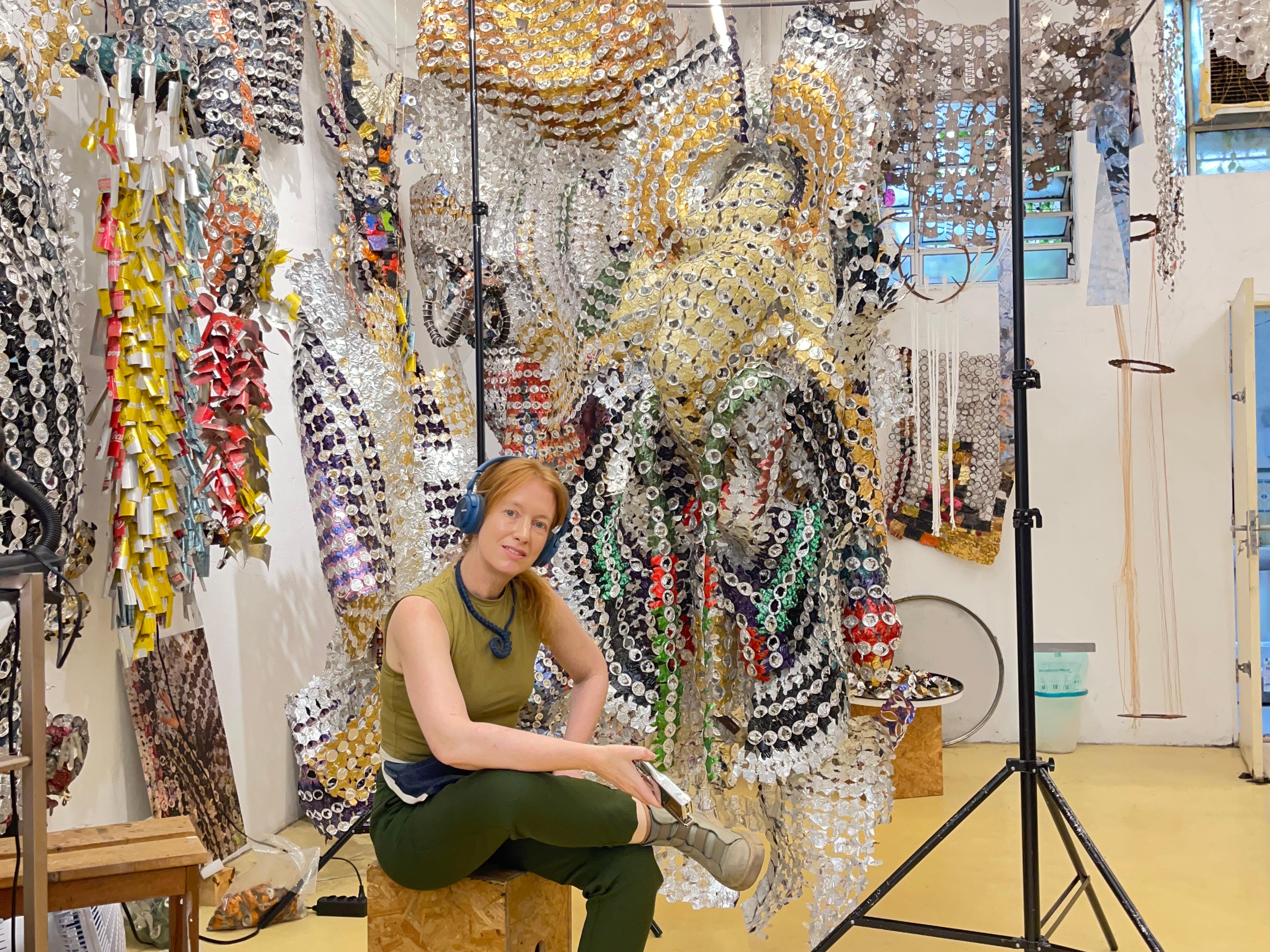
In this exclusive interview, we delve into the artistic vision of Sandra Lapage, the June winner of the MyMA Artist Grant. Based in São Paulo, Sandra’s work navigates the complex interplay between control and chaos, drawing inspiration from everyday and discarded materials. Her practice challenges conventional perceptions of value and beauty, inviting us to reconsider our relationship with the world around us. Join us as we explore Sandra’s creative process, her influences, and the profound messages embedded in her art.
Your work draws on concepts of magical thought and shamanic practices. Can you elaborate on how these ideas influence your creative process?
The idea of magic is, for me, connected to a notion of wonder and enchantment: all types of poetry (literary, musical, visual) are an example of magical thought that aim at creating a sense of enchantment. Myths and indigenous considerations of nature sought an understanding of the world based on the notion of nature and all elements as sacred, which seems to have been lost in the occidental notion of never ending progress and of earth as a resource to take and use at will. In recent years, the climate crisis clearly denies the idea that earth is filled with inexhaustible resources, and urges a re-sacralization of nature.
On the other hand, creative work is traversed by an alternation between states of trance and consciousness, which oscillates between hyper attention and pure presence and reaction to materiality. I understand my work as a possibility to immerse myself in action but also in a thought process that, in a certain way, draws on ‘defocusing’ my mind by letting materiality unfold into object in contact with my hands, but also molding my thoughts and esthetic responses – which do not pertain to rationality and draws into different sources. These sources are what interest me.
My creative process is a path for me to access these realms and modes of thought, slowly undoing years of training into a purely rational, processual, intellectual and repetitive idea of control as means to lead my life.
You reference a variety of thinkers such as Jung, Bergson, Bennett, Stengers, and Narby. How do their ideas manifest in your work?
Jung speaks of mana and magical/unconscious value of objects and of collective unconscious, Bergson of élan vital, and Jane Bennett of vibrant matter - in all cases considering the potential of life in inanimate matter. Isabelle Stengers speaks of animism from a scientific standpoint, while Jeremy Narby proposes that knowledge is passed from generation to generation through a universal DNA - a common code shared by all living things.
Although these ideas have not been scientifically tested, they point to a need to reevaluate the way western thought and society have been evolving. This evolution is clearly taking us, as a human collectivity and part of a bigger living organism which is our biosphere, to the brink of ecological catastrophe. So I find that these thinkers, and I would also include Edgar Morin (artists as shamans), Stefano Mancuso (collaboration instead of competition in Nature) and Marcelo Gleiser (life as a are and invaluable occurrence in the cosmos), are suggesting that we need to have a philosophical reassessment of our modes of life, and this is what I find precious in their ideas.
Going back to my work, it seems to me that the notion of genetic communication nears the notion of a collective unconscious. There is imagery that is drawn from a collective unconscious, and I believe it manifests in my work.
All of these lines of thought point to a reverence and respect to all things, living or not. It is an ecological perception of the world. By dealing with refuse as a material base for my work, I consider trash or discarded materials as valuable and something to consider with care. I also understand that my intention is not the biggest player in my encounter with materiality, it is more of a dialogue with what is around me and the weight of previous generations, and not so much an expression of an individual.
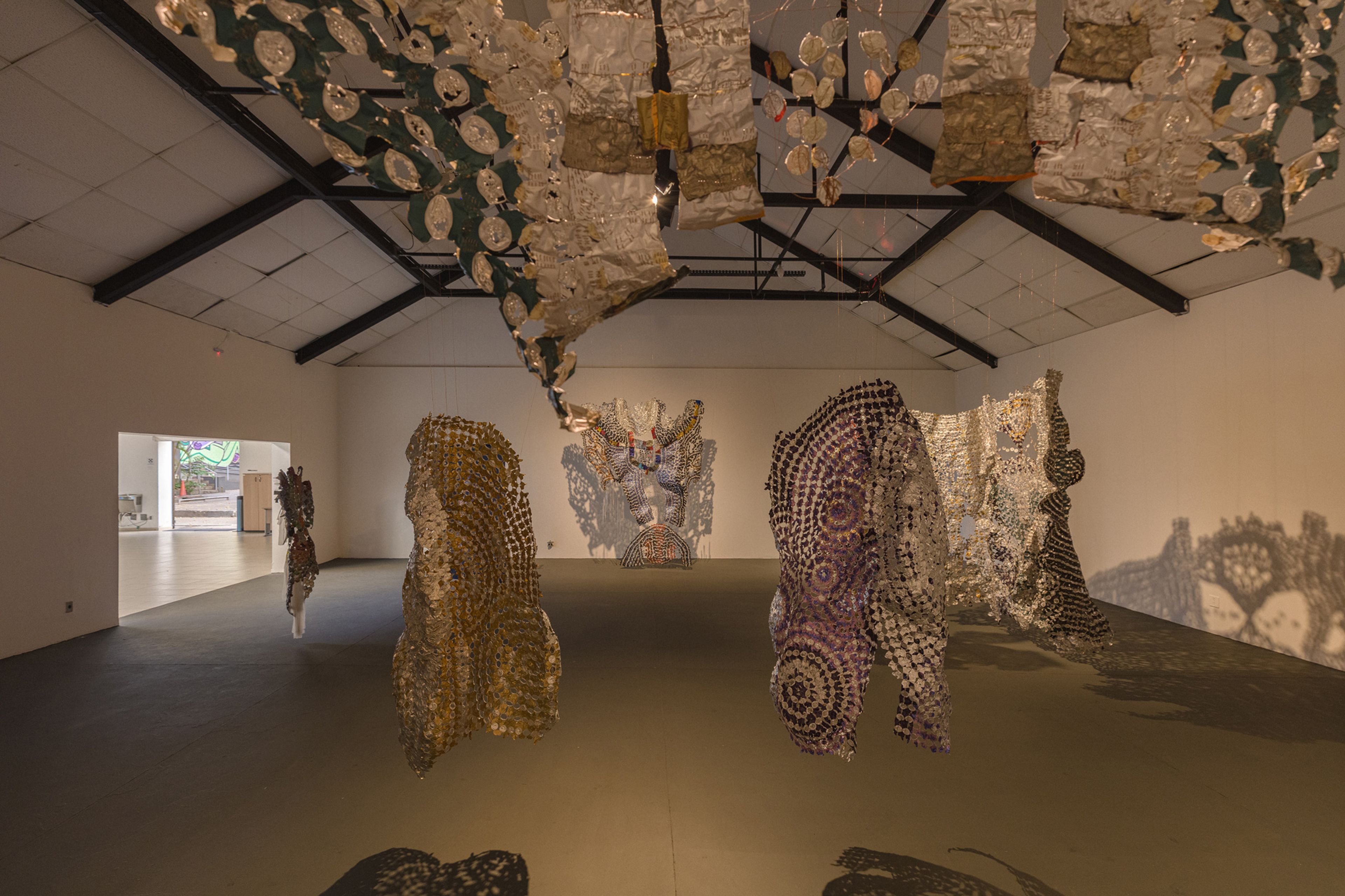
You use recycled and discarded materials, especially coffee capsules. What drew you to these specific materials, and what is their significance in your work?
I’ve always enjoyed working on a scale that engages the scale of the body, so working in accumulation is part of my process. Therefore, working with what is already available solves the problem of creating more stuff, especially when not all that I make leads me to something interesting.
I started working with recycled materials quite tentatively, trying to put together a few recycled elements and wondering if I would ever get enough of any material to create something with an impact. Accumulation is paramount to address the idea of excess. But with trash and serialized objects that is never a problem, isn’t it? Quite on the contrary: this specific material – coffee capsules – appeared in my daily life, in the last years in large quantities, as clearly people consume coffee capsules in large amounts, and feel inclined to donate them. By working with donated materials, I organically engage people into a conversation around the volume and kind of trash each of us produces, and around conscious decisions around what and how we consume – decisions that I continuously learn to take in my own everyday life.
Can you walk us through your process of transforming these industrial materials into malleable, wearable sculptures and installations?
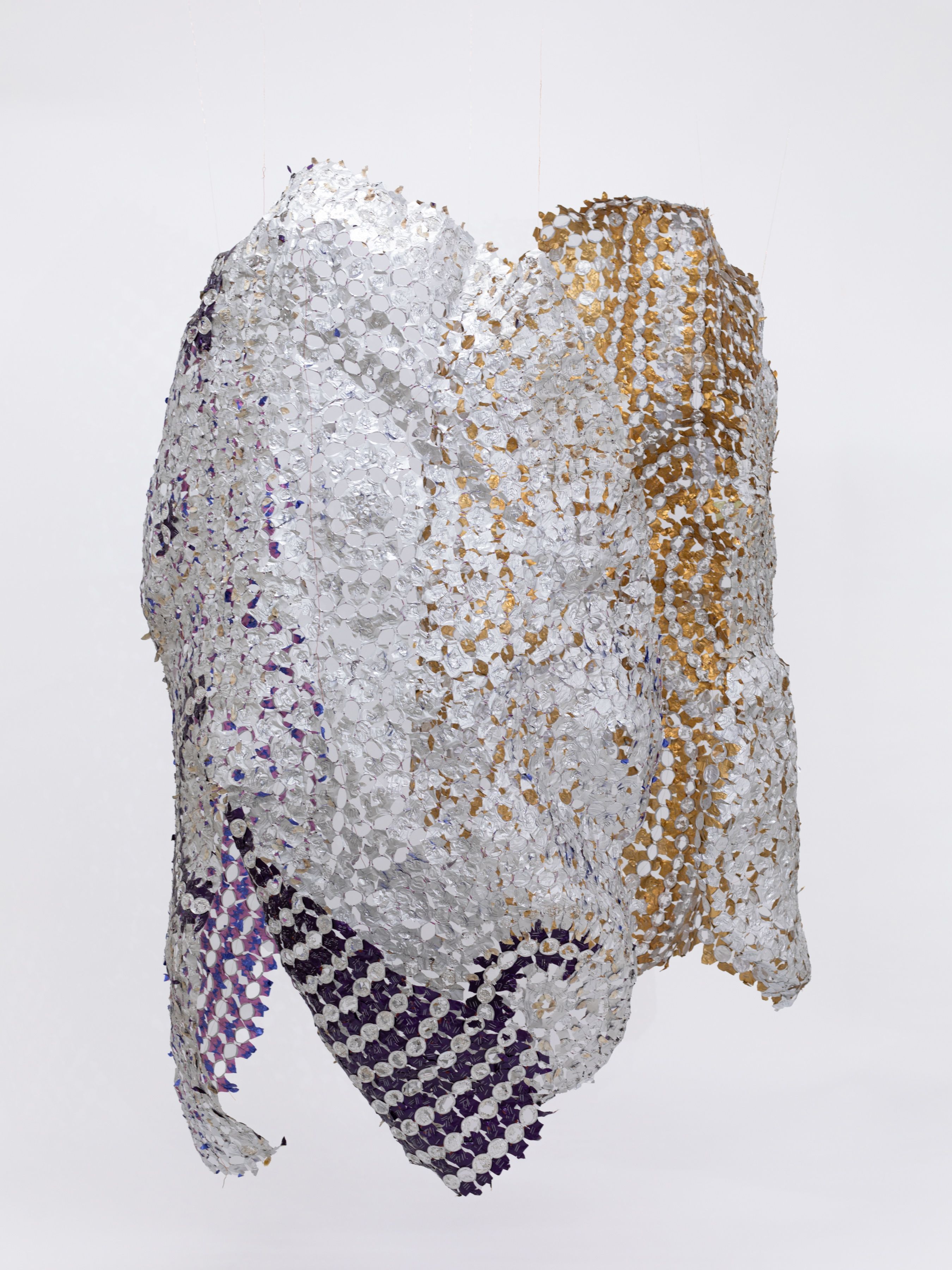
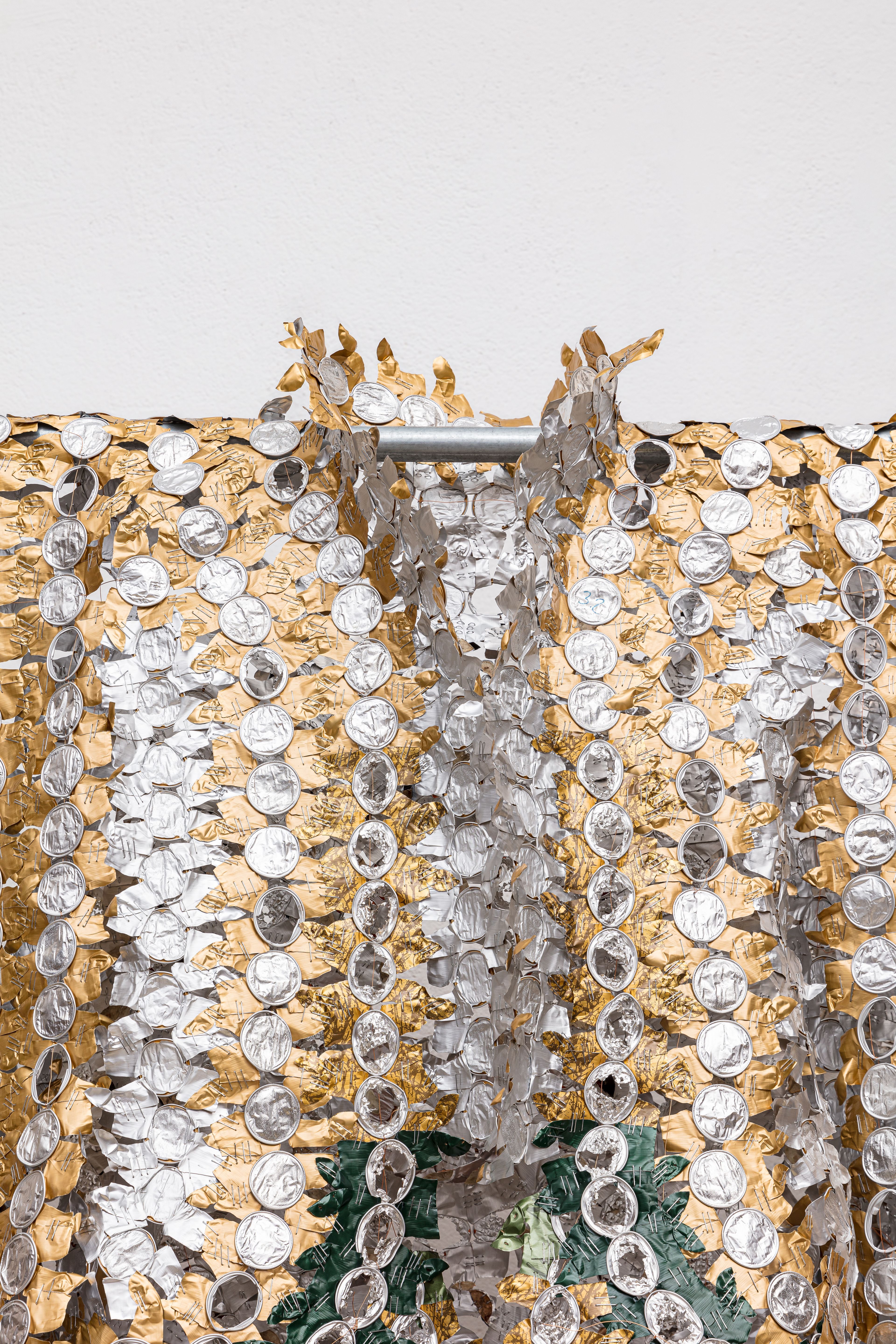
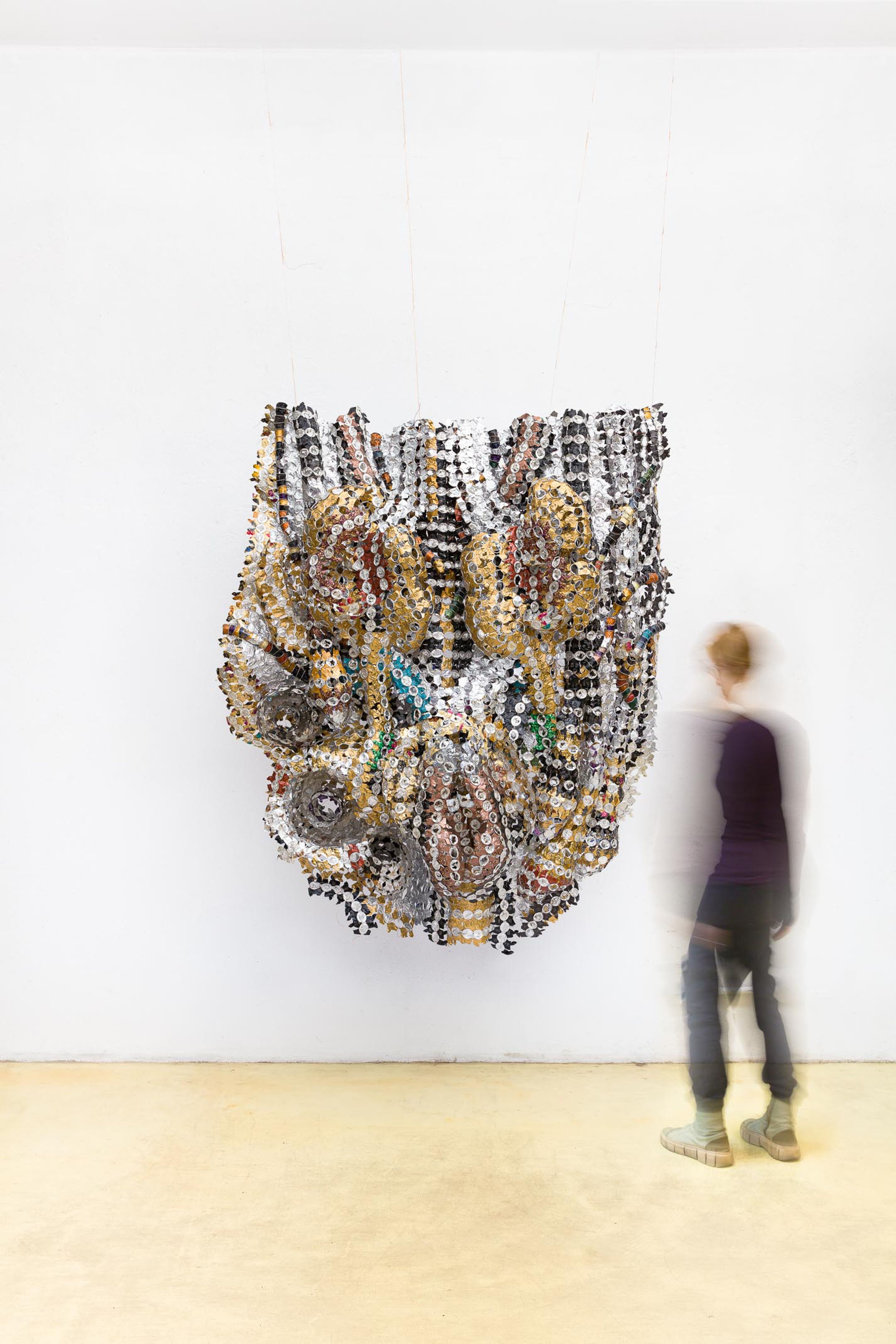
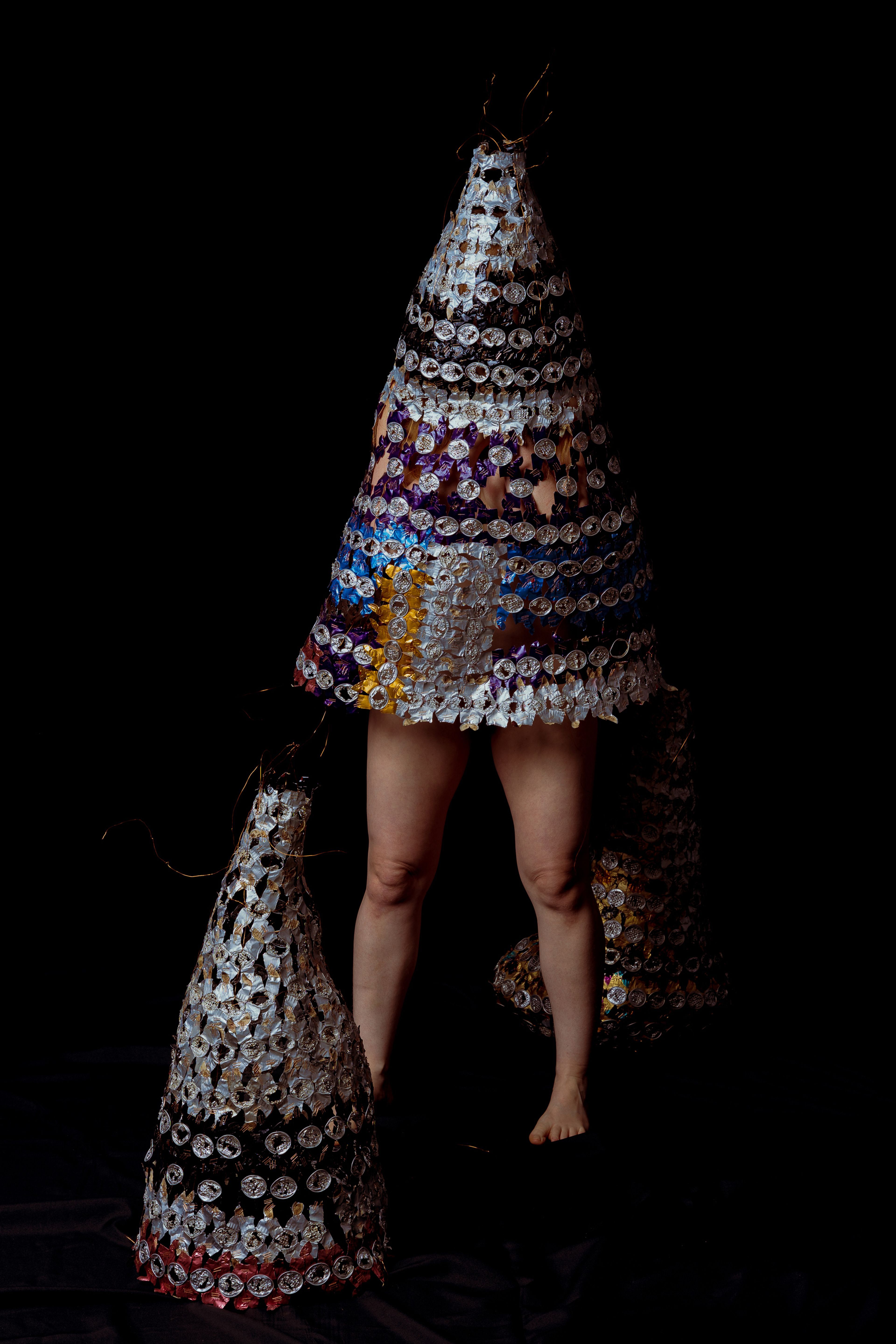
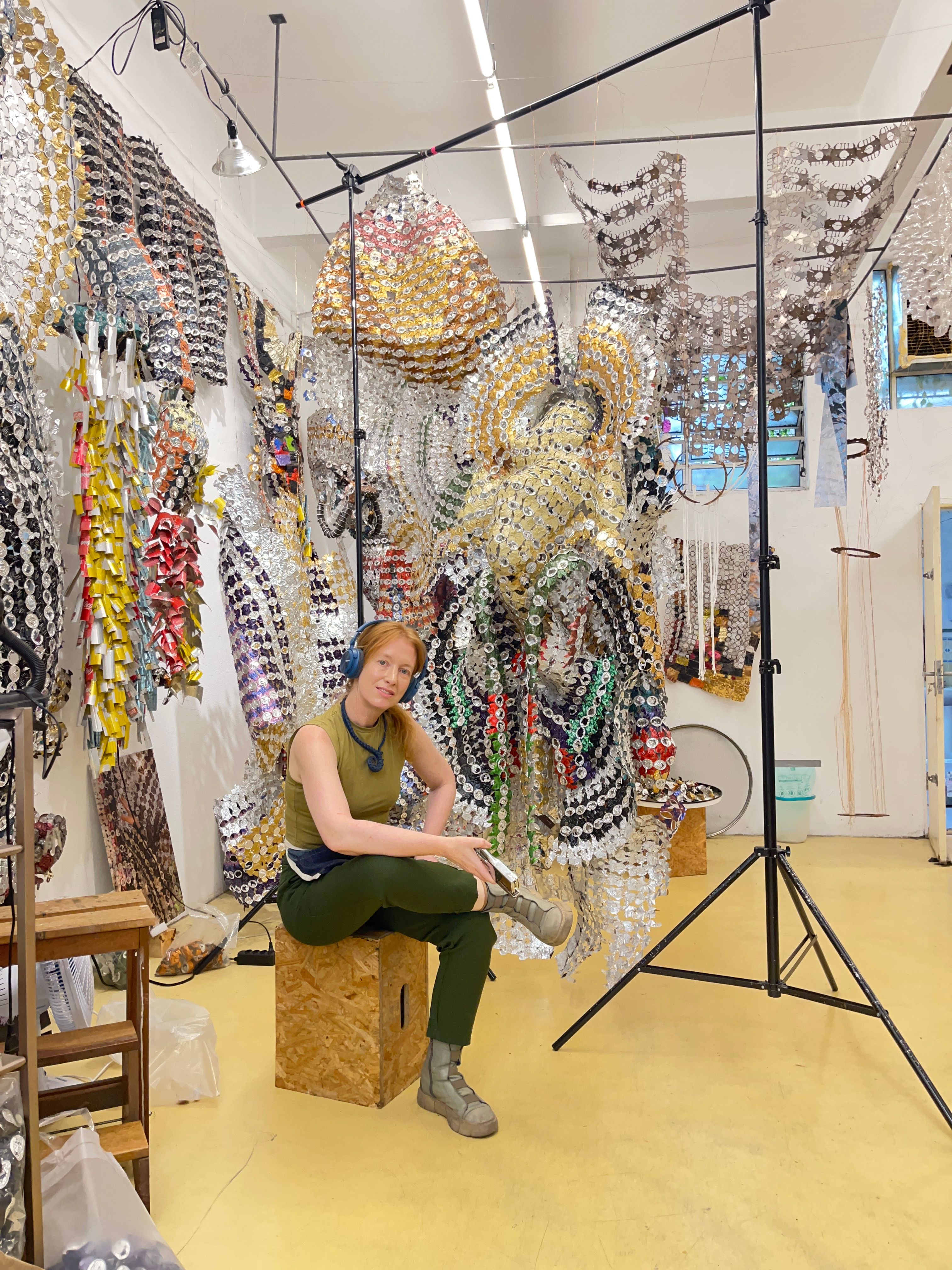
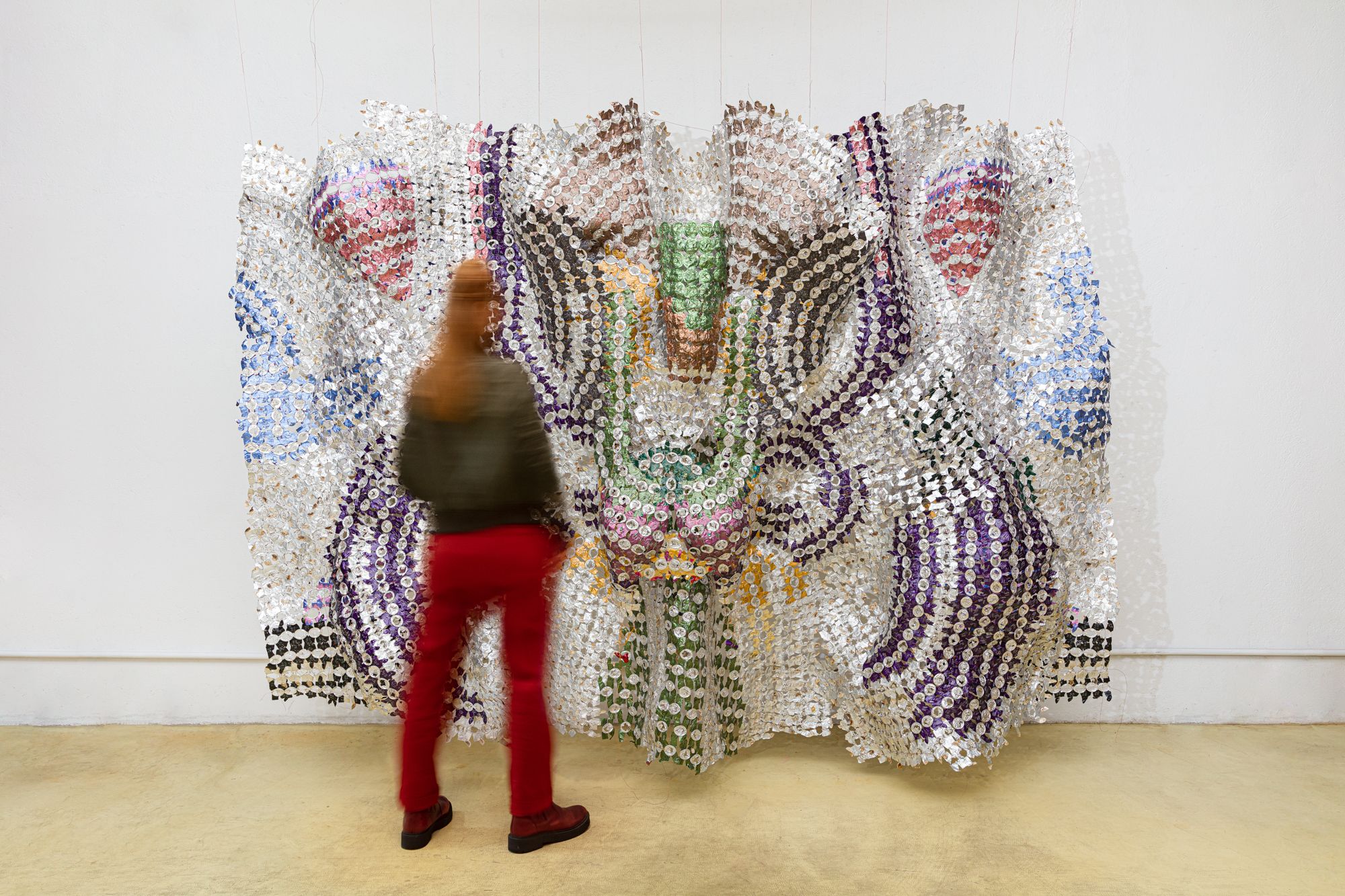
The coffee capsules go through a lengthy process of cutting through the aluminum, removing the used ground, moldy coffee, a first soaking, a process of flattening by hand each of these elements, and finally cleaning them thoroughly by soaking and brushing off most coffee and moldy traces. After this process of cleaning and flattening, these small pods become individually shaped units that, assembled together, become a weft, which in turns acquires textile qualities: it is a ductile material which accepts folds and layers, and behave as textile constructions in space.
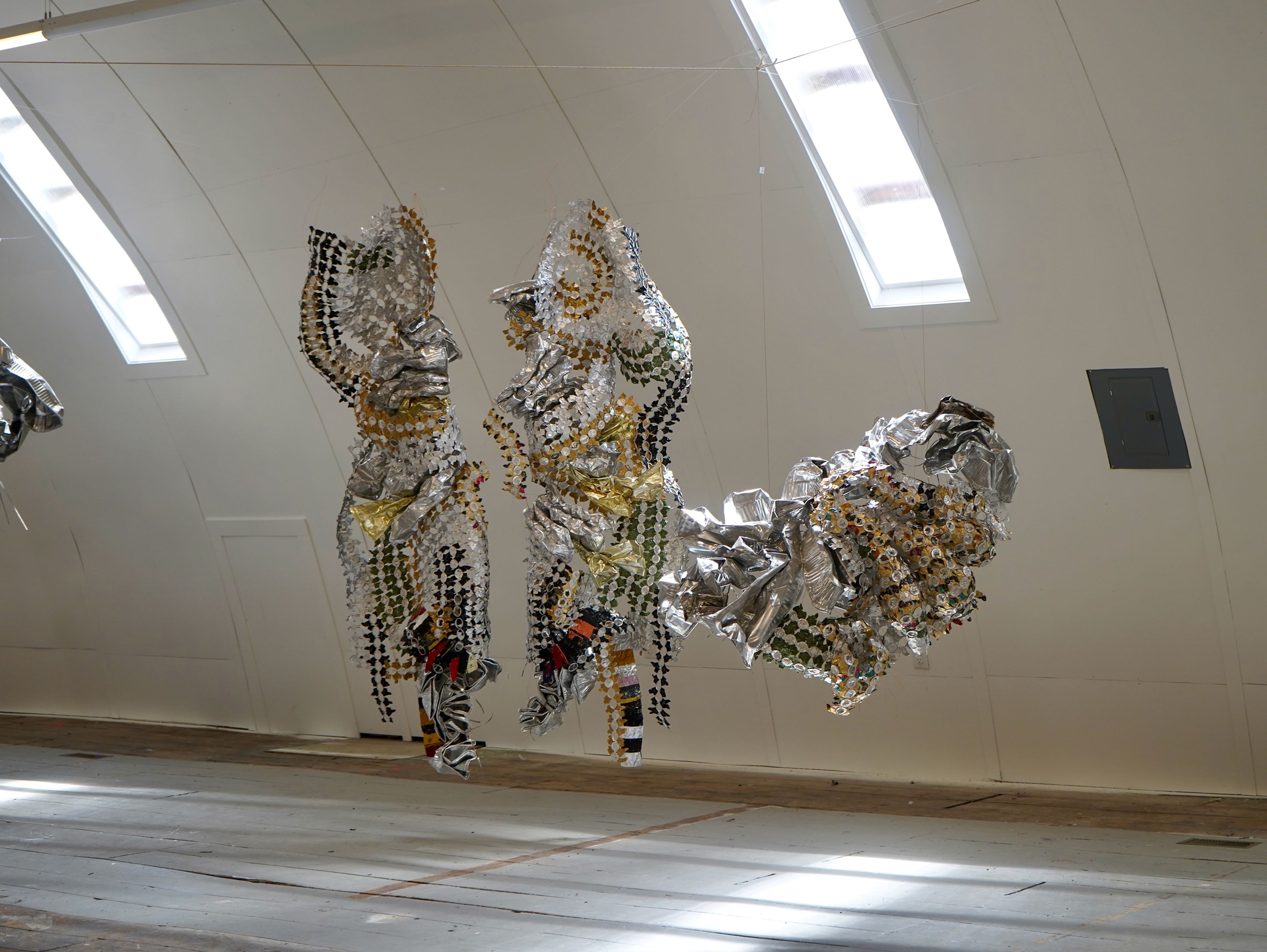
How does the act of reusing materials on a large scale address issues of consumption, luxury, and societal values in your view?
The sheer volume of recycled material that I get through donations address the amount of trash that a consumerist society creates, through a small sample of a much larger problem - the problem of trash, pollution and climate change.
Can you share an experience where "not knowing" played a crucial role in your artistic process or led to a significant breakthrough?
There is a beautiful text by Ann Hamilton called “Making not knowing”. I often go back to it as it resonates strongly with how I feel about art that gets to new paths without knowing at the beginning where it is headed. It is an opening into the unknown and also has the upside of avoiding one’s preconceived notions, which might contain one’s possibilities within a limited scope of action. Not knowing frees me from endlessly repeating what I’ve previously done. It frees me from the fear of failure and from the lack of courage to jump into the unknown. It helps me to understand failure as simply something completely unexpected, and that might be turned into something somehow. It teaches me acceptance and to exercise a change in perspective.
Can you share any specific experiences or sources of inspiration that have had a profound impact on your artistic journey?
Seeing the work of other artists that work with recycled materials has had a profound transformative impact on my work, as I like to work in large scale and in accumulation; the only way for me to feel ok with accumulation and the creation of large objects when there is already so much excessiveness around me is to use exceeding materials.
How do you start a new piece?
By playing around with the material of choice, I follow vague hunches which may or may not lead me to something interesting - it is a kind of dialogue with the material, which seems to indicate whether this or that esthetic or structural path might take me to an exciting result or not. Often, I feel like this method of not planning and following a vague tactile process leads me to finding new problems; problems to solve; problems which reveal themselves to be, in fact, new solutions rather than a problem.
What does a typical studio day look like for you?
Walking from home to the studio, meeting my artist friends at our collective space, swiping the floor or finding something else to do for the space, tending to it, giving it some love. We drink a lot of coffee together - mostly brewed in our French press. In the late afternoons, sometimes we tune into a French online radio called FIP which has a very eclectic selection, and the studio gets into a party vibe in which our spaces get connected through music.
Do you listen to music or podcasts while you work?
I have phases, as I consider music as an important path to activate the senses and the mind. Although I consider music as a facilitator to access trance-like states, I would say that half of the time I work in silence, which helps me forget myself and does not draw continuously on conscious memories, conjectures or projections. Certain kinds of music are more appropriate for that, especially dissonant, as well as improvisational ones.
Can you share any specific experiences or sources of inspiration that have had a profound impact on your artistic journey?
There are so many important artists that shaped my path! To start with, nature artists such as Marinette Cueco and Tracey Deep. Then, thinking of wefts, I was profoundly inspired by Lenore Tawney’s work, and then by Ruth Asawa, Sheila Hicks, and Olga de Amaral. Recently I’ve been looking at Sabine Tiemroth’s work.
Artists who work with recycled materials have had a profound impact on helping me find my way working with recycled industrial materials. There are many great artists working today, and to name a few: Alice Hope, Virginia Fleck, Lisa hoke, El Anatsui, Moffat Takadiwa, Tracy Luff, Serge Attukwei, Michelle Stitzlein, Christina Massey, Ann Carrington, Annelies Horden.
Bispo do Rosário is a Brazilian outsider artist of major importance. His prolific work has had international impact, especially his wearable textile and woven pieces, which he created in views of his own passing – he was a mystic which clearly found solace in his monumental body of work. His mantles have always been a great inspiration to me.
Mrinalini Mukherjee has an extraordinary body of work that deals with woven wefts that unfold into space as anthropomorphic shapes that seem to allude to faceless deities, often feminine.
I love Magdelena Abakanowicz’s work scale, with huge textile shapes that confront the scale of the viewer and sometimes invite them “inside”.
Can you describe a particularly memorable exhibition or project that stands out in your career so far, and what made it special to you?
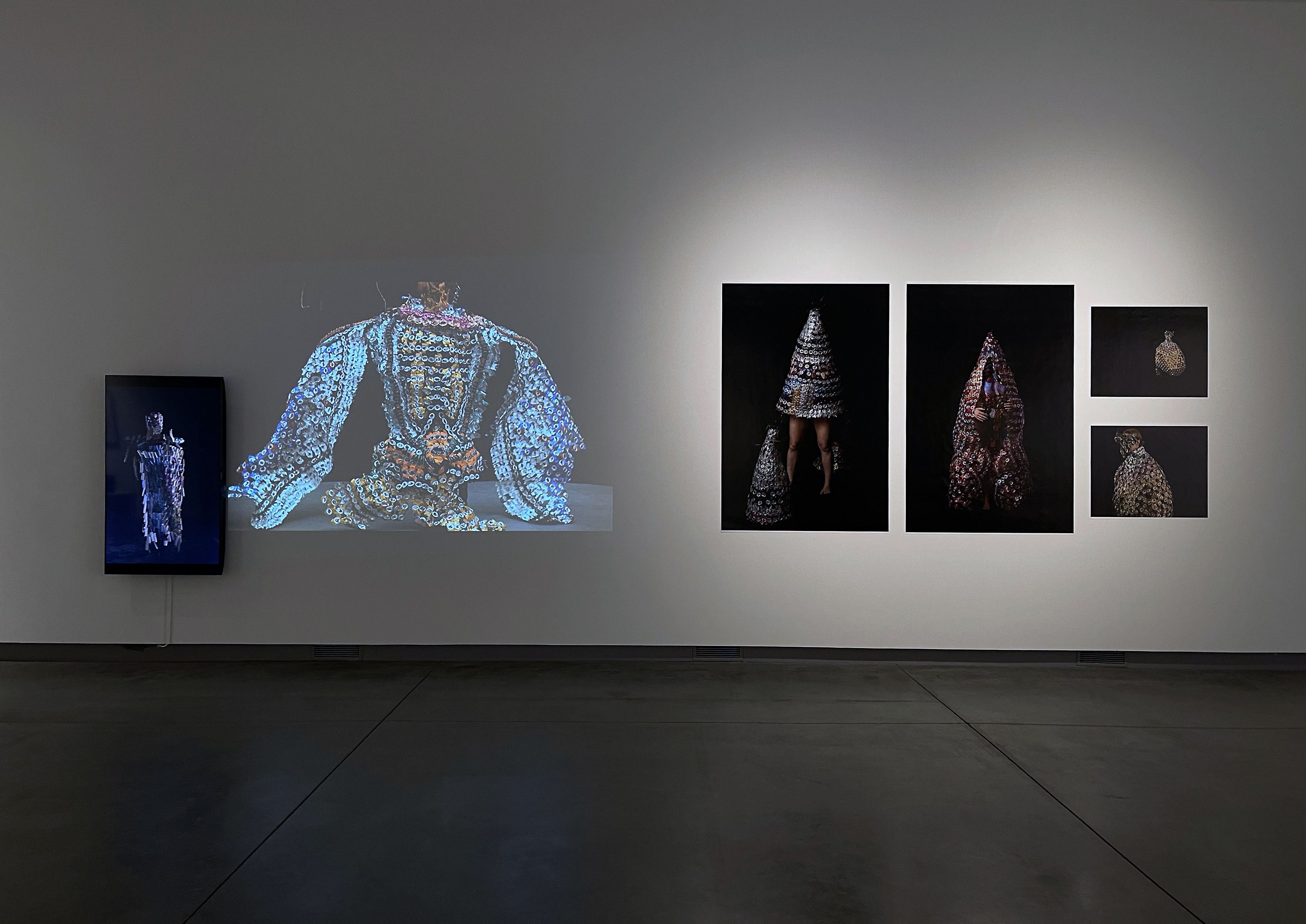
Last year I had a large scale solo show at Fundação Nacional das Artes in São Paulo, and the huge tall ceiling gallery gave me ample opportunity to install all of my biggest pieces and experiment with sound (inferring the inherent possibility of life in the pieces), installation (the pieces were floating lightly in space, away from the walls, some close to the ground, others floating high above the viewer’s head) and video (in which I exemplify what it feels and looks like to wear the pieces). I also wrecked with a critical text that was inserted within the exhibition, as voice over, interspaced with the video pieces and the sound pieces. It was all very sensorial and imbued with darkness and mystery.
Who are some contemporary artists you’re looking at now?
I am looking intently at Barbara Chase-Ribboud, Cristina Camacho, Jacqueline Surdell, Rebecca Horn for wearable sculpture and Marcel Dzama to inspire the next videos wearing my sculptures. I also enjoy looking at fashion, namely Iris Van Herpen and images from the exhibition Sleeping Beauties: Reawakening Fashion at the Met Museum.
You live in São Paulo! Do you have a favorite memory in the city? How has living in São Paulo influenced your work?
São Paulo is a hectic, vibrant, 12 million people metropolitan area (the bigger São Paulo, which comprehends its actual metropolitan area beyond municipal limits, is over 20 million inhabitants): it is huge. Often, it is terribly cruel and harsh. Sometimes, it is fun and groovy. Despite its hard edges and tough aspects, I love it.
But I also know that this environment is a logistic and infrastructural nightmare, hyper urban, detached from nature. Urban environment cuts us off from nature, which becomes more and more an abstract concept that is hard to relate to, something to consider as dangerous, foreign and that has to be kept off from our everyday lives.
All of this reflects on me and on the materials I use: hyper industrial, but trying to reconnect to nature somehow. I think this is why biophiliac shapes are recurrent in my work, as I am preoccupied with ideas of climate change, ecological crisis and the unknown in Nature, but also because I am unconsciously drawn to bilateral symmetry and organic forms, which are typical of life in nature.
How do you see your art evolving in the future, and are there any new themes or mediums you are interested in exploring?
I wish to start exploring textile industrial refuge, as it is one of the greatest sources of trash. The biggest challenge will be to merge textile and metal, something that I’ve tried in the past and which has definitely not worked out. It all depends on which type of refuge I will find!
I also see a structural possibility for these metallic wefts to evolve and space and respond to an architectural environment. As I create wearable pieces, these are too uncomfortable to offer as an experience for the viewer. Therefore, I am considering creating temporarily inhabitable pieces which would work as wearable pieces on the scale of architecture.
What’s the most unusual material you’ve ever worked with, and how did it turn out?
In a residency in Spain called Nectar, the owners had a very large Pyrenean Mountain Dog. This dog typically shed a lot of its hair, and knowing that I like to experiment with new materials, they proposed that I try to use a whole bag of the dog’s hair, which turned out quite interestingly. In the same residency, an artist friend from Holland became a fan of local candy, which came wrapped within the prettiest colors and motifs – she gave me all the wrappers and that was the origin of “a Dress for Efigenia”, honoring Brazilian outsider artist Efigenia, Queen of Candy Wrappers. Look her up! This 80 year old artist and poet is amazing. And finally, since 2016 I have been creating a weft – in progress up to now – with my own hair, which I collect from my hair brush.
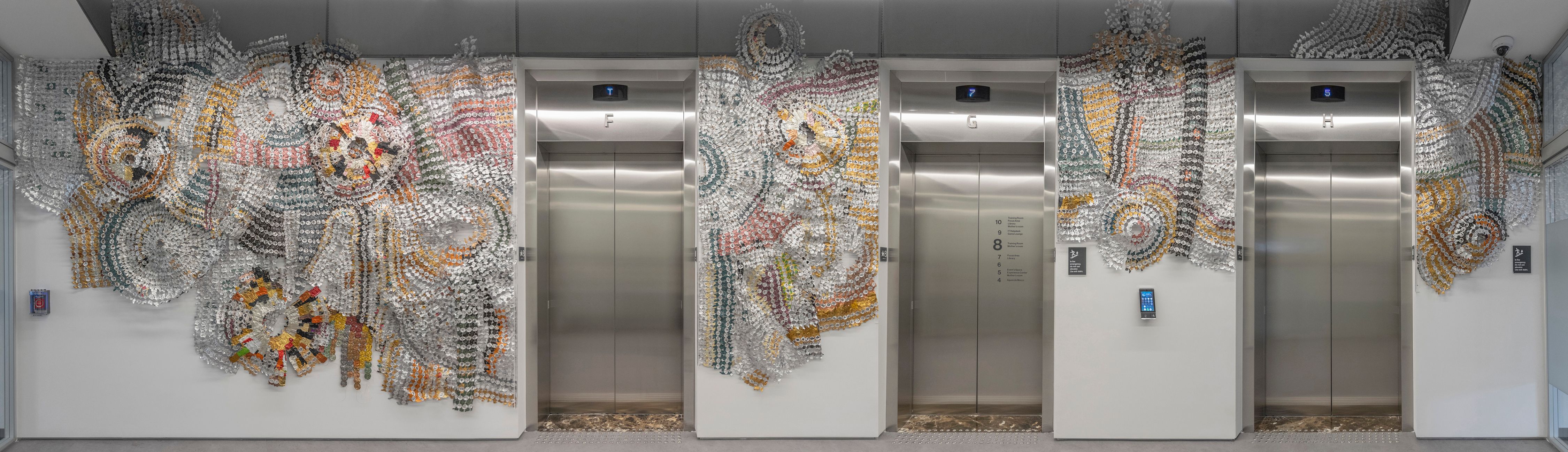
Sandra Lapage lives and works in São Paulo, Brazil. She is a 2022–23 Pollock-Krasner Foundation grantee and a 2021 Repaint History Artist Fund recipient. Sandra earned her MFA from the Maine College of Art in 2013 and has exhibited her work in Brazil, Europe, Asia, and the United States. Notable exhibitions include shows at the Ribeirão Preto Art Museum, Brazilian Embassy in Brussels, Centro Cultural São Paulo, Blumenau Art Museum, A60 Contemporary Artspace (Milan), Kunsthalle am Hamburguer Platz (Berlin), CICA Museum (Korea), The Royal Society of American Art (NYC), and Espronceda (Spain). In 2022, she participated in the Alumni Triennial at the Institute of Contemporary Art, Portland, and created a site-specific installation for Meta’s São Paulo offices. Recent solo shows include Complexo Cultural Funarte São Paulo and Universidade Estadual de Londrina (2023), Galeria Eduardo Fernandes (São Paulo), Galeria Refresco (Rio de Janeiro), and upcoming solo show at Kapow Gallery, New York, in 2024. Sandra has been awarded the Odyssée grant twice, enabling residencies at institutions such as Fondation Château Mercier (Switzerland) and Chateau de Goutelas (France), and has been a resident at the NARS Foundation (NYC), Massachusetts Museum of Contemporary Art, Bogliasco Foundation and Art OMI. Her work has been featured in Artishok Revista (Chile), Artmarket Magazine, Friend of the Artist, Create Magazine, and on TV series “um.artista” and “_bases SESI Lab” at Canal Arte1, Brazil. She has also served as a visiting artist at the Tyler School of Art and Maine College of Art in the United States.